AI-Powered Mobile CT Scanners Indicate a Diagnostics-Driven Transformation in the Mobile Healthcare Market
The Business Research Company’s Mobile Healthcare Global Market Report 2026 – Market Size, Trends, And Forecast
Press Release Disclaimer: This is a press release distributed through the XPR Media network. It has not been independently verified by our newsroom.

The Business Research Company’s Mobile Healthcare Global Market Report 2026 – Market Size, Trends, And Forecast 2026-2035
LONDON, GREATER LONDON, UNITED KINGDOM, October 16, 2026 /EINPresswire.com/ — The mobile healthcare sector is rapidly evolving, driven by technological advances and increasing demand for convenient, accessible health services. Innovations like AI-powered diagnostics are transforming how care is delivered, bringing sophisticated medical tools directly to patients. This overview explores the mobile healthcare market’s size, growth drivers, key players, and emerging trends shaping its future.
Market Size and Growth Outlook in the Mobile Healthcare Market
The mobile healthcare market is set to surpass $221 billion by 2030. It forms a significant part of the broader Healthcare Technology industry, which is projected to reach approximately $1,458 billion by the same year, with mobile healthcare contributing around 15% of that total. Within the larger Information Technology sector, forecasted to hit $13,788 billion by 2030, this market will represent close to 2% of the overall value. The industry is expected to expand at a healthy compound annual growth rate (CAGR) of 17% through 2030.
Request A Free Sample Of The Mobile Healthcare Market Report
https://thebusinessresearchcompany.com/sample_request?id=85139148&type=smp&name=Mobile%20Healthcare%20Market%20Report%202026&utm_source=EINPresswire&utm_medium=Paid&utm_campaign=Oct_PR
Regional Leaders Fueling Mobile Healthcare Market Revenues
In 2030, North America is anticipated to be the leading region in mobile healthcare revenues, reaching $82 billion, up from $37 billion in 2025. This growth, also at a 17% CAGR, is supported by the widespread adoption of connected health technologies, increased use of mobile health applications for managing chronic illnesses, rising smartphone and wearable medical device penetration, demand for remote patient engagement, and strong healthcare IT infrastructure alongside favorable reimbursement policies promoting digital health services.
The USA’s Role as the Largest National Market in Mobile Healthcare
The United States is projected to hold the top spot among countries in the mobile healthcare market, with a market value of $73 billion in 2030, growing from $33 billion in 2025 at a CAGR of 17%. This expansion is driven by factors such as the growing prevalence of chronic diseases requiring ongoing monitoring, the rise of telehealth and virtual care solutions, significant investments in digital health innovation, broad implementation of remote patient monitoring by healthcare providers, increasing consumer interest in personalized care, and tighter integration of mobile health technologies into routine clinical workflows.
Access The Detailed Mobile Healthcare Market Report Here
https://thebusinessresearchcompany.com/report/mobile-healthcare-global-market-report?utm_source=EINPresswire&utm_medium=Paid&utm_campaign=Oct_PR
Dominance of Blood Glucose Monitors in Mobile Healthcare Devices
Among device categories, blood glucose monitors are forecasted to be the largest segment in 2030, accounting for 23% of the market or $51 billion. This leadership is fueled by the increasing global diabetic population, rising adoption of connected glucose monitoring systems, heightened awareness of preventive care, technological advances in continuous glucose monitoring, real-time health tracking through apps, and a growing demand for convenient home-based monitoring solutions.
Breakdown of Mobile Healthcare Market Segments
The mobile healthcare market is also segmented by service type, including treatment services, diagnostic services, monitoring services, wellness and fitness solutions, and other services. Stakeholders in the market comprise mobile network operators, healthcare providers, application or content developers, and other participants, each playing a vital role in the ecosystem.
Key Factors Driving Rapid Growth in the Mobile Healthcare Market
Several major trends are propelling the market forward. Firstly, the expansion of reimbursement codes for remote patient monitoring is encouraging more healthcare providers and payers to support continuous remote care, resulting in broader adoption of mobile healthcare solutions and connected devices. This factor is expected to add approximately 2.3% annual growth.
Secondly, there is an increasing demand for home-based remote patient monitoring services. Patients prefer care that allows them to track their health conveniently without frequent hospital visits. Mobile technologies enable real-time monitoring, timely interventions, and easier access to care, especially benefiting older adults and individuals with chronic conditions. This trend is likely to contribute about 2.1% to yearly growth.
Thirdly, the integration of mobile health platforms with national electronic health record (EHR) systems is speeding up clinical adoption. Connecting apps to EHRs facilitates faster clinical decisions and more comprehensive patient data management. As healthcare organizations adopt connected ecosystems to improve coordination, reduce administrative burden, and share information more effectively, global digitization efforts will significantly boost demand for interoperable mobile health tools. This driver is expected to contribute roughly 1.9% annual growth.
The Transformative Impact of AI-Enabled Mobile Diagnostics
Artificial intelligence-powered mobile diagnostic tools are revolutionizing the mobile healthcare landscape by enhancing point-of-care imaging, improving clinical efficiency, and expanding access to advanced diagnostics. A notable example is Samsung India’s collaboration with NeuroLogica in August 2025 to introduce AI-enabled mobile CT scanners in India. These portable devices facilitate easier access to imaging, reduce the need for patient transfers, and accelerate diagnosis in critical care, emergency, and specialized medical environments.
Apple Inc.’s Leading Position in the Mobile Healthcare Market
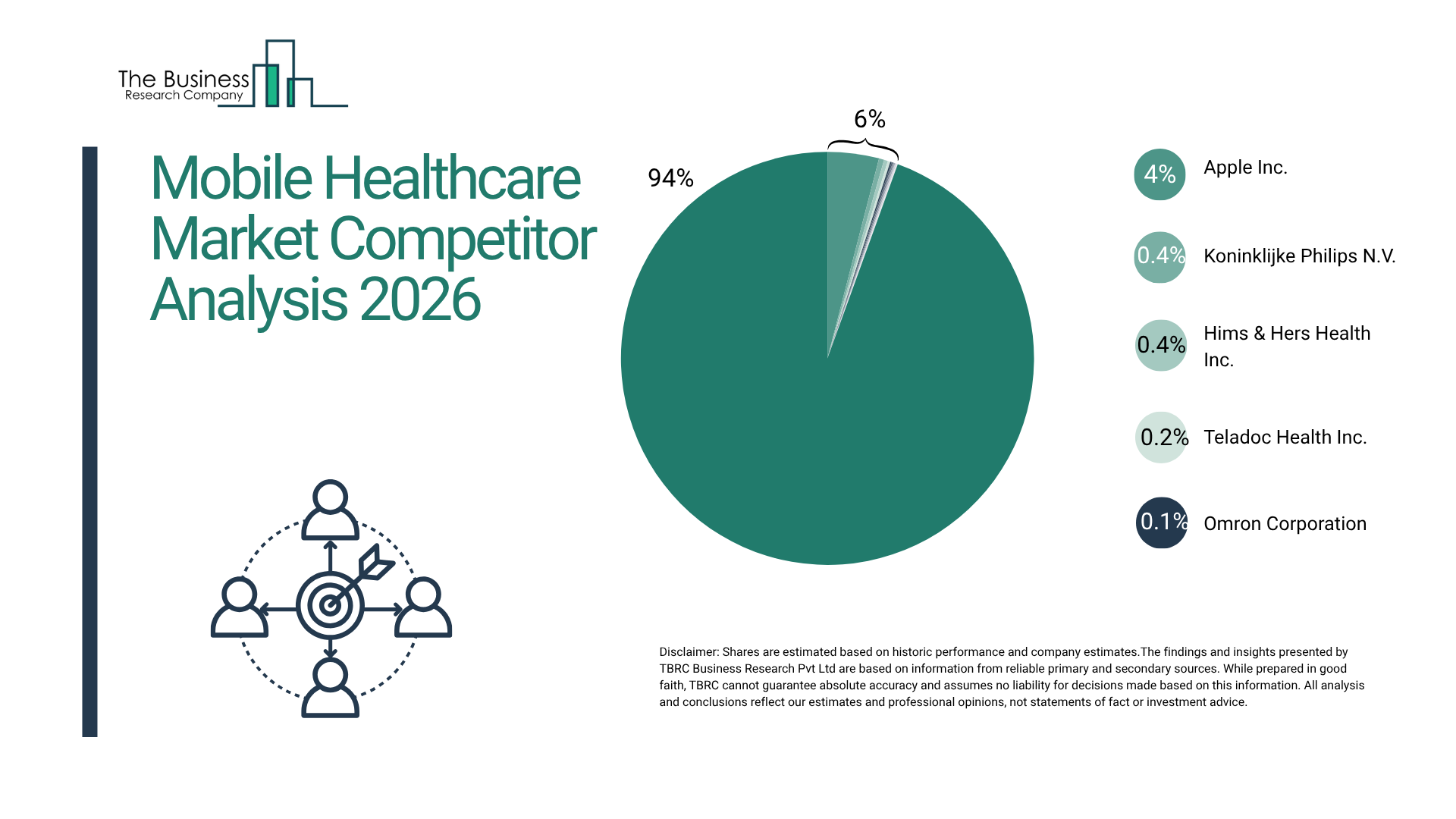
In 2024, Apple Inc. emerged as the global market leader with a 4% share, according to The Business Research Company. The company’s portfolio in digital health, directly impacting mobile healthcare, includes health apps, wearable devices, remote monitoring solutions, and digital health features that promote personal wellness, preventive care, and integrated healthcare management.
Key Players Competing in the Mobile Healthcare Industry
Other prominent companies competing in the mobile healthcare market include Koninklijke Philips N.V., Hims & Hers Health Inc., Teladoc Health Inc., Omron Corporation, Dexcom Inc., Masimo Corporation, Amwell Inc., BioTelemetry Inc., One Medical Group Inc., Omada Health Inc., Withings S.A., AliveCor Inc., Doctor On Demand Inc., Carbon Health Inc., AgaMatrix Inc., K Health Inc., HealthTap Inc., 98point6 Inc., Lemonaid Health Inc., and Forward Health Inc.
Fragmented Market Structure with Leading Companies Holding Small Shares
The mobile healthcare market is highly fragmented, with the top 10 companies accounting for just 6% of total revenue in 2024. Barriers to entry range from low to moderate, influenced by evolving standards for health data privacy, compliance with digital health regulations, challenges in technology integration, and the reliability requirements for mobile and connected care solutions. Leading firms maintain their positions through diversified digital health platforms, strong healthcare partnerships, global technology networks, and continuous innovation. As demand grows for remote monitoring, telehealth, wearables, and personalized care, these companies are expected to strengthen their foothold via collaborations, new products, and geographic expansion.
Market Shares of Leading Companies in 2024
The market shares of top players in 2024 were:
– Apple Inc.: 4%
– Koninklijke Philips N.V.: 1%
– Hims & Hers Health Inc.: 0.4%
– Teladoc Health Inc.: 0.2%
– Omron Corporation: 0.1%
– Dexcom Inc.: 0.1%
– Masimo Corporation: 0.1%
– Amwell Inc.: 0.1%
– BioTelemetry Inc.: 0.1%
– One Medical Group Inc.: 0.04%
Competitive Strategies Driving the Mobile Healthcare Market
Key strategies shaping competition include advancing mobile diagnostic technologies to enhance point-of-care healthcare, deploying remote patient monitoring solutions to optimize care delivery and efficiency, expanding digital healthcare infrastructure to support connected care, and integrating AI technologies to improve diagnostic accuracy and automation.
Device Segments with the Largest Market Potential
All eight device categories—blood glucose monitors, cardiac monitors, hemodynamic monitors, neurological monitors, respiratory monitors, body and temperature monitors, remote patient monitoring devices, and others—present significant growth opportunities. Collectively, these segments are projected to add over $120 billion in value by 2030. From 2025 to 2030, blood glucose monitors are expected to increase by $27 billion, cardiac monitors by $24 billion, remote patient monitoring devices by $23 billion, body and temperature monitors by $15 billion, respiratory monitors by $13 billion, hemodynamic monitors by $7 billion, other device types by $6 billion, and neurological monitors by $5 billion. This expansion is driven by rising chronic and lifestyle disease prevalence, wider connected device adoption, digital healthcare access, emphasis on preventive and continuous health management, and advances in wireless monitoring technology—reflecting the sector’s focus on patient-centric care, clinical efficiency, and timely health insights.
Mobile Healthcare Market Value Chain Participants
The value flow within the mobile healthcare market involves several key segments:
– Raw material suppliers: Companies like Medtronic plc, Koninklijke Philips N.V., Abbott Laboratories, Siemens Healthineers AG, GE HealthCare Technologies Inc., Johnson & Johnson, Boston Scientific Corporation, Stryker Corporation, Becton Dickinson and Company, Baxter International Inc., Edwards Lifesciences Corporation, Zimmer Biomet Holdings Inc., Intuitive Surgical Inc., ResMed Inc., Dexcom Inc., Insulet Corporation, Masimo Corporation, iRhythm Technologies Inc., BioTelemetry Inc., AliveCor Inc., Omron Healthcare Inc., Garmin Ltd., Withings SAS, Nonin Medical Inc., and Hillrom Holdings Inc.
– Wholesalers and distributors: Major distributors include McKesson Corporation, Cardinal Health Inc., Cencora Inc., Henry Schein Inc., Medline Industries LP, Owens & Minor Inc., Patterson Companies Inc., Morris & Dickson Co. LLC, Anda Inc., H.D. Smith LLC, Smith Drug Company, Concordance Healthcare Solutions LLC, FFF Enterprises Inc., Dakota Drug Inc., McKesson Medical-Surgical Inc., Bunzl Healthcare, Medex Supply Inc., Byram Healthcare Inc., Direct Supply Inc., Bound Tree Medical LLC, Concordance Healthcare Solutions, Concordance Medical Solutions, Medline Canada Corporation, Mediq B.V., and Movianto Group.
– End users: Prominent end users encompass Teladoc Health Inc., Amwell Corporation, Doctor On Demand Inc., Babylon Health Limited, Ada Health GmbH, K Health Inc., Hims & Hers Health Inc., Roivant Sciences Ltd., GoodRx Holdings Inc., CVS Health Corporation, Walgreens Boots Alliance Inc., Walmart Health, Amazon Pharmacy, UnitedHealth Group Incorporated, Humana Inc., Elevance Health Inc., Kaiser Permanente, Mayo Clinic, Cleveland Clinic, Johns Hopkins Medicine, HCA Healthcare Inc., Ascension Health, Providence Health & Services, Apollo Hospitals Enterprise Limited, and Fortis Healthcare Limited.
Our 2026 reports feature deeper market intelligence with market attractiveness scoring and analysis, total addressable market (TAM) analysis, company scoring matrix graphics and tables, Excel-based forecasting dashboards, market hotspots infographics, key technologies and future trend analysis, and updated graphics and tables.
Learn More About The Business Research Company
The Business Research Company (www.thebusinessresearchcompany.com) is a leading market intelligence firm renowned for its expertise in company, market, and consumer research. We have published over 30,000+ reports across 27 industries and 60+ geographies. Our research is powered by 1,500,000 datasets, extensive secondary research, and exclusive insights from interviews with industry leaders.
We provide continuous and custom research services, offering a range of specialized packages tailored to your needs, including Market Entry Research Package, Competitor Tracking Package, Supplier & Distributor Package and much more.
Disclaimer: Please note that the findings, conclusions and recommendations that TBRC Business Research Pvt Ltd delivers are based on information gathered in good faith from both primary and secondary sources, whose accuracy we are not always in a position to guarantee. As such TBRC Business Research Pvt Ltd can accept no liability whatever for actions taken based on any information that may subsequently prove to be incorrect. Analysis and findings included in TBRC reports and presentations are our estimates, opinions and are not intended as statements of fact or investment guidance.
Contact Us:
The Business Research Company
Americas +1 310-496-7795
Europe +44 7882 955267
Asia & Others +44 7882 955267 & +91 8897263534
Email: marketing@tbrc.info
Follow Us On:
LinkedIn: https://in.linkedin.com/company/the-business-research-company
Oliver Guirdham
The Business Research Company
+44 7882 955267
info@tbrc.info
Visit us on social media:
LinkedIn
Facebook
X
Legal Disclaimer:
EIN Presswire provides this news content “as is” without warranty of any kind. We do not accept any responsibility or liability
for the accuracy, content, images, videos, licenses, completeness, legality, or reliability of the information contained in this
article. If you have any complaints or copyright issues related to this article, kindly contact the author above.

Media gallery