
Simulation, Mapping, and Processing Tools Expected to Contribute More Than $0.7 Billion to the Lidar Software Market
The Business Research Company’s Lidar Software Global Market Report 2026 – Market Size, Trends, And Forecast 2026-2035
Press Release Disclaimer: This is a press release distributed through the XPR Media network. It has not been independently verified by our newsroom.
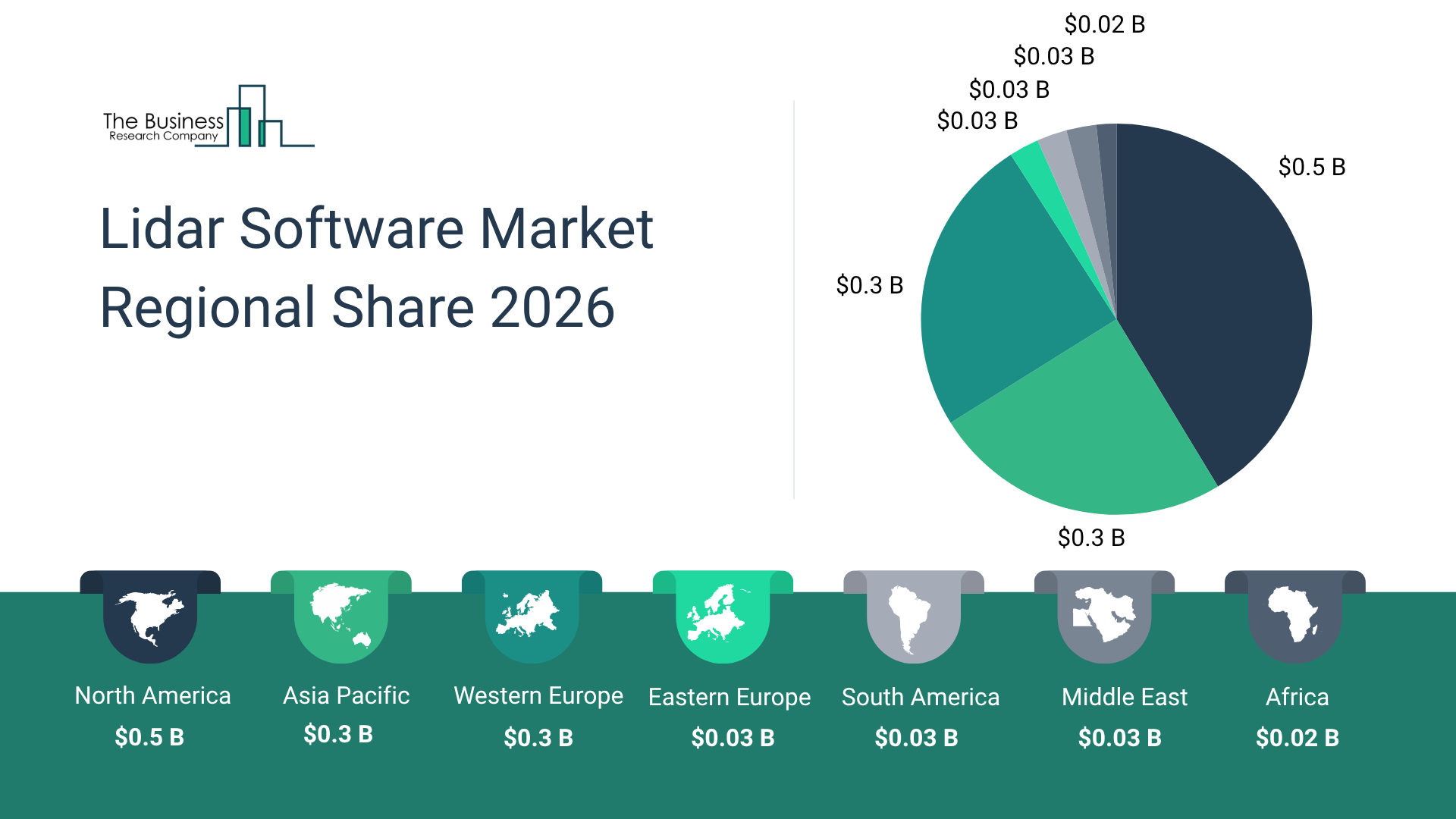

The Business Research Company’s Lidar Software Global Market Report 2026 – Market Size, Trends, And Forecast 2026-2035
LONDON, GREATER LONDON, UNITED KINGDOM, October 16, 2026 /EINPresswire.com/ — The lidar software market is evolving rapidly, driven by advances in processing capabilities and growing demand across various industries. As competition intensifies among technology providers, new innovations and strategic partnerships are shaping the future landscape. Let’s explore the current status, key players, driving forces, and emerging trends that are defining this dynamic market.
Significant Growth in the Lidar Software Market’s Simulation, Mapping, and Processing Segments
Between 2025 and 2030, the combined value of lidar software’s simulation, mapping, and processing segments is expected to increase by more than $0.7 billion, with processing software leading this surge. Companies specializing in geospatial technologies, mapping solutions, autonomous systems, and analytics platforms are competing primarily on AI-enhanced point cloud processing, cloud-native geospatial workflows, precise mapping, integration with digital twins, and real-time visualization. Critical factors shaping their competitive edge include scalable data management, automated feature extraction, and interoperability across multiple platforms.
Request A Free Sample Of The Lidar Software Market Report
https://thebusinessresearchcompany.com/sample_request?id=85155177&type=smp&name=Lidar%20Software%20Market%20Report%202026&utm_source=EINPresswire&utm_medium=Paid&utm_campaign=Oct_PR
The Competitive Landscape Shows Moderate Fragmentation with Top Players Holding Nearly One-Quarter of Revenue
The lidar software market exhibits moderate fragmentation, with ten leading companies accounting for 24% of total revenue in 2024. Barriers to entry include advanced requirements for point cloud analytics, accurate geospatial data handling, AI-based object classification, and expertise in extensive spatial computing. Market leaders maintain their positions through extensive lidar software offerings, strong relationships with surveying and infrastructure sectors, integrated hardware-software ecosystems, continuous advancements in mapping and visualization, and innovations supporting digital twins, autonomous systems, precision mapping, and real-time spatial intelligence. Continued development in software interoperability and technology partnerships is expected to reinforce their dominance.
Market Shares of Leading Companies in 2024
– Trimble Inc. — 3%
– Leica Geosystems AG — 3%
– Faro Technologies Inc. — 3%
– Teledyne Optech — 3%
– Shanghai Huace Navigation Technology Ltd. (CHCNAV) — 3%
– Luminar Technologies Inc. — 2%
– Innoviz Technologies Ltd. — 2%
– Cepton Technologies Inc. — 2%
– Aptiv PLC — 2%
– Quanergy Systems Inc. — 2%
Access The Detailed Lidar Software Market Report Here
https://thebusinessresearchcompany.com/report/lidar-software-global-market-report?utm_source=EINPresswire&utm_medium=Paid&utm_campaign=Oct_PR
Key Competitive Strategies Driving the Lidar Software Market
Leading companies focus on several strategic areas to maintain their edge: enhancing AI-powered point cloud analytics for more accurate data interpretation; developing cloud-based lidar platforms to accelerate geospatial workflows; integrating digital twins to advance infrastructure and urban planning applications; enabling real-time lidar processing for autonomous mobility ecosystems; and automating feature extraction to boost efficiency in surveying and mapping.
Trimble Inc. as the Market Leader in 2024
Trimble Inc. secured the top spot in global lidar software sales in 2024 with a 3% market share, according to The Business Research Company. Their portfolio includes geospatial software and solutions related to lidar, covering point cloud processing, mapping, data management, and spatial analytics platforms. These tools support high-precision surveying, infrastructure modeling, asset management, and geospatial intelligence across government, construction, transportation, and environmental monitoring sectors.
Prominent Players Competing in the Lidar Software Market
In addition to Trimble Inc., other notable competitors include Leica Geosystems AG, Faro Technologies Inc., Teledyne Optech, Shanghai Huace Navigation Technology Ltd. (CHCNAV), Luminar Technologies Inc., Innoviz Technologies Ltd., Cepton Technologies Inc., Aptiv PLC, Quanergy Systems Inc., GeoCue Group Inc., GreenValley International, YellowScan, Outsight SA, Routescene, Seoul Robotics, SimActive, Terrasolid Ltd., Neuvition Inc., and Geo-Plus.
Lidar Software Market Expected to Surpass $1 Billion by 2030
Forecasts predict the lidar software market will grow beyond $1 billion by 2030. This segment exists within the larger Digital Technology market, which is expected to reach approximately $4,811 billion by that year, with lidar software representing about 0.03% of the total. Within the broader Information Technology sector, projected to hit $13,788 billion, lidar software would account for nearly 0.01%. The market is set to expand at a compound annual growth rate (CAGR) of 19% through 2030.
Processing Software Dominates the Lidar Software Market by 2030
Among product categories—simulation, mapping, and processing software—processing software is predicted to hold the largest share in 2030, constituting 45% of the market or around $1 billion. This dominance is driven by the increasing volumes of lidar datasets requiring advanced analytics, the rising need for automated extraction and object recognition, growing use of machine learning for data interpretation, broader applications of high-resolution spatial intelligence, and continuous software improvements boosting accuracy, scalability, and workflow efficiency.
Additional Market Segmentation by Technology, Deployment, and Application
The lidar software market is further broken down by sensor technology into mechanical and solid-state variants. Deployment types include airborne and terrestrial systems. Applications are categorized across forestry and environmental monitoring, surveying and mapping, automotive, construction and infrastructure, and other fields.
North America Leads in Lidar Software Market Revenue, with Strong Growth in the USA
North America is anticipated to hold the largest share of the lidar software market in 2030, valued at $0.47 billion, up from $0.19 billion in 2025, reflecting a CAGR of 20%. This growth is fueled by expanding use of lidar-enabled autonomous and semi-autonomous systems, increased geospatial intelligence in infrastructure and environmental sectors, investments in digital twins and smart cities, demand for precise 3D analytics, and a robust ecosystem of software developers and innovators advancing lidar data processing.
Within this region, the USA is projected to be the top country in lidar software revenue, expected to reach $0.41 billion by 2030, rising from $0.17 billion in 2025 at a CAGR of 19%. Its growth levers include lidar software adoption for transportation planning and roadway mapping, rapid commercialization of autonomous vehicles, uptake of cloud-based spatial data platforms, demand for real-time terrain modeling and asset management, and continuous advances in AI-driven point cloud classification and visualization.
Three Key Factors Driving Lidar Software Market Expansion
The global lidar software market is set to benefit from three main influences:
Affordable Solid-State Sensors Energizing Automotive Design Wins
Solid-state lidar sensors priced below USD 500 are making the technology accessible for many passenger and commercial vehicles, accelerating adoption in driver assistance and autonomous driving systems. The resulting surge in lidar data volume increases demand for advanced software that processes, visualizes, and interprets this information, pushing vendors to enhance analytics, object detection, and real-time perception. This factor is expected to contribute about 2.3% annual growth to the market.
UN R-157 Autonomous-Driving Regulation Encourages Wider Deployment
The UN R-157 regulation sets operational safety standards for autonomous vehicles, encouraging broader use of automated driving technologies. Compliance necessitates software capable of validating sensor performance, supporting simulation, and delivering reliable perception, thus driving investments in lidar software along the autonomous mobility value chain. This driver is estimated to add roughly 2.0% annual growth to the market.
US Infrastructure Grants Promote Corridor and Climate-Resilience Mapping
Government investment in transportation modernization, flood risk assessment, environmental monitoring, and infrastructure resilience is generating more high-resolution geospatial data. These projects require sophisticated platforms for terrain modeling, change detection, asset inspection, and large-scale mapping, enhancing demand for lidar data management and analytics. This factor is projected to contribute about 1.7% annual growth to the market.
The Impact of AI Sensor Fusion on the Lidar Software Market
AI-powered sensor fusion platforms are transforming the lidar software landscape by enhancing real-time situational awareness, improving the accuracy of threat detection, and automating security intelligence within critical infrastructure.
For example, in September 2025, Ouster partnered with Constellis to integrate its Gemini lidar software platform and digital lidar technology into the Constellis LEXSO operational intelligence platform. This collaboration brings a real-time lidar analytics engine, AI-driven sensor fusion, automated object classification, and multi-sensor data integration, improving threat detection, reducing false alarms, and enabling faster decision-making in complex security and surveillance environments.
Lidar Software Market Segments to Generate Over $0.7 Billion in Growth
The simulation, mapping, and processing software segments are set to offer the largest growth opportunities in the lidar software market, collectively adding more than $0.7 billion in value by 2030. Processing software is expected to contribute $0.3 billion, while mapping and simulation software will each add around $0.2 billion from 2025 to 2030. This growth will be driven by the adoption of digital twins and virtual testing, demand for highly accurate geospatial intelligence in infrastructure and environmental applications, the need for automated point cloud interpretation, and advancements in AI analytics and cloud-based spatial data platforms, highlighting the rise of scalable lidar data ecosystems.
Connecting Chipmakers, Resellers, and Autonomous Vehicle Developers in the Lidar Software Market
Key raw material providers in this market include NVIDIA Corporation, Advanced Micro Devices Inc. (AMD), Intel Corporation, Qualcomm Technologies Inc., Micron Technology Inc., Samsung Electronics Co. Ltd., SK Hynix Inc., Western Digital Corporation, Seagate Technology Holdings plc, Broadcom Inc., Marvell Technology Inc., Taiwan Semiconductor Manufacturing Company (TSMC), GlobalFoundries Inc., Cadence Design Systems Inc., Synopsys Inc., Ansys Inc., Keysight Technologies Inc., Hexagon AB, Esri Inc., and HERE Technologies.
Large wholesalers and distributors comprise Carahsoft Technology Corp., TD SYNNEX Corporation, Ingram Micro Holding Corporation, Arrow Electronics Inc., Avnet Inc., Redington Limited, Westcon-Comstor, Exclusive Networks SA, ScanSource Inc., Digital China Holdings Limited, Softchoice Corporation, SHI International Corp., Insight Enterprises Inc., CDW Corporation, Bechtle AG, Computacenter plc, SoftwareOne, and Dicker Data Limited.
Prominent end users include Waymo LLC, Cruise LLC, Aurora Innovation Inc., Zoox Inc., John Deere, Caterpillar Inc., Komatsu Ltd., Trimble Agriculture, WSP Global Inc., AECOM, Jacobs Solutions Inc., HDR Inc., US Geological Survey (USGS), National Aeronautics and Space Administration (NASA), Rio Tinto Group, BHP Group Limited, Southern Company, and National Grid plc.
New additions to our 2026 reports:
• Market attractiveness scoring and analysis
• Total addressable market (TAM) analysis
• Company scoring matrix graphics and tables
• Excel-based forecasting dashboards
• Market hotspots infographics
• Key technologies and future trend analysis
• Updated graphics and tables
Learn More About The Business Research Company
The Business Research Company (www.thebusinessresearchcompany.com) is a leading market intelligence firm renowned for its expertise in company, market, and consumer research. We have published over 30,000+ reports across 27 industries and 60+ geographies. Our research is powered by 1,500,000 datasets, extensive secondary research, and exclusive insights from interviews with industry leaders.
We provide continuous and custom research services, offering a range of specialized packages tailored to your needs, including Market Entry Research Package, Competitor Tracking Package, Supplier & Distributor Package and much more.
Disclaimer: Please note that the findings, conclusions and recommendations that TBRC Business Research Pvt Ltd delivers are based on information gathered in good faith from both primary and secondary sources, whose accuracy we are not always in a position to guarantee. As such TBRC Business Research Pvt Ltd can accept no liability whatever for actions taken based on any information that may subsequently prove to be incorrect. Analysis and findings included in TBRC reports and presentations are our estimates, opinions and are not intended as statements of fact or investment guidance.
Contact Us:
The Business Research Company
Americas +1 310-496-7795
Europe +44 7882 955267
Asia & Others +44 7882 955267 & +91 8897263534
Email: marketing@tbrc.info
Follow Us On:
LinkedIn: https://in.linkedin.com/company/the-business-research-company
Oliver Guirdham
The Business Research Company
+44 7882 955267
info@tbrc.info
Visit us on social media:
LinkedIn
Facebook
X
Legal Disclaimer:
EIN Presswire provides this news content “as is” without warranty of any kind. We do not accept any responsibility or liability
for the accuracy, content, images, videos, licenses, completeness, legality, or reliability of the information contained in this
article. If you have any complaints or copyright issues related to this article, kindly contact the author above.

Media gallery

