Faraday Future Announces Execution Roadmap for Its “Built in USA” Acceleration Program and Launches Distributor Recruitment; Targets to Bring Its New Robot Factory Online by Year-End and First New EAI Device Product Off the Line in February 2027
LOS ANGELES, CA, August 27, 2026 (EZ Newswire) -- Faraday Future Intelligent Electric Inc. (NASDAQ: FFAI) (“Faraday
Press Release Disclaimer: This is a press release distributed through the XPR Media network. It has not been independently verified by our newsroom.
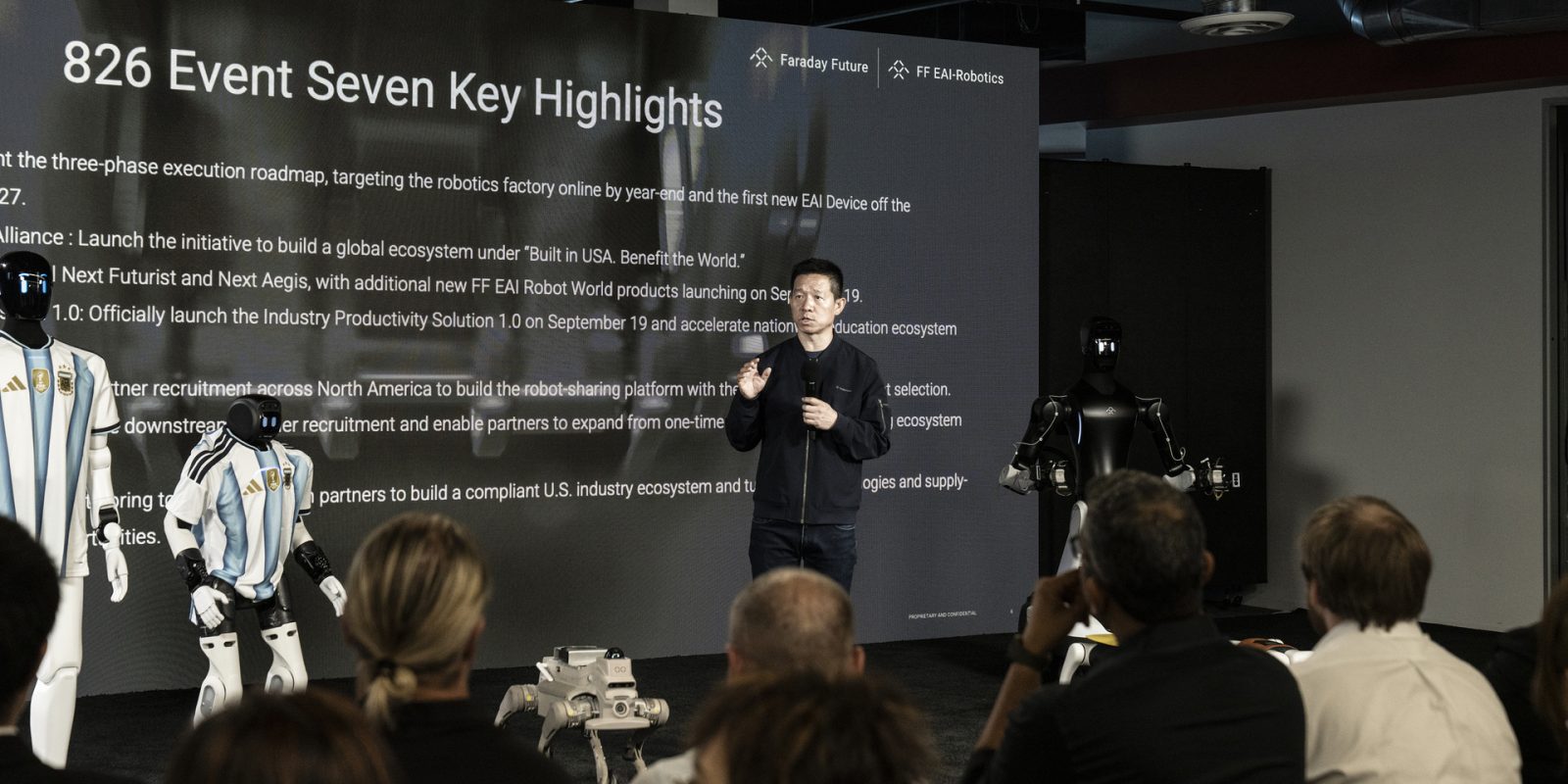

LOS ANGELES, CA, August 27, 2026 (EZ Newswire) — Faraday Future Intelligent Electric Inc. (NASDAQ: FFAI) (“Faraday Future”, “FF” or the “Company”), a California-based global Embodied AI (EAI) ecosystem company, today held its first ever FF EAI Robotics “Built in USA” Upstream & Downstream Business Partner Conference at its LA headquarters. FF made numerous announcements and Company updates, including presenting the three-phase execution roadmap for FF EAI Robotics’ “Built in USA” Acceleration Program.
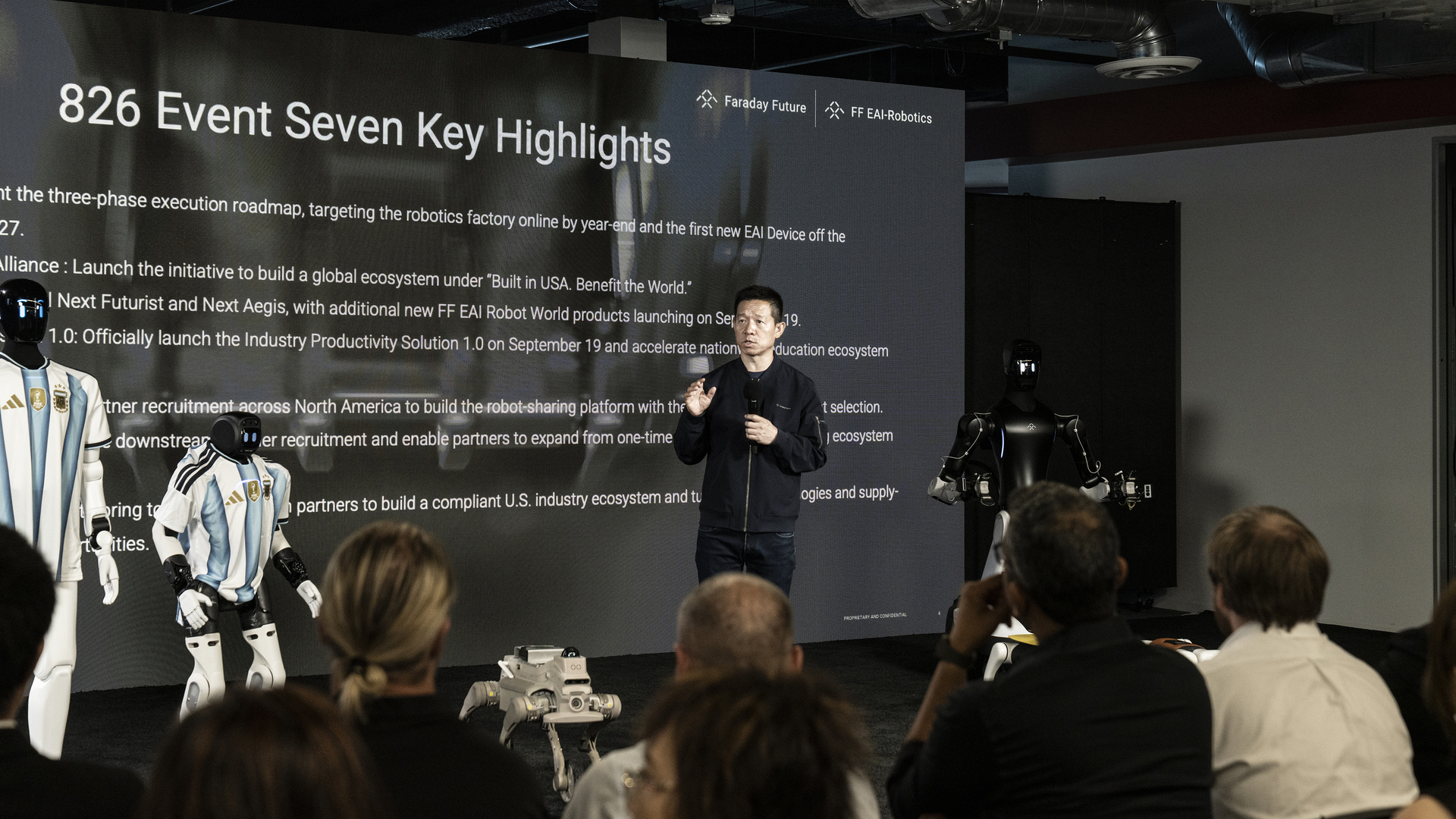
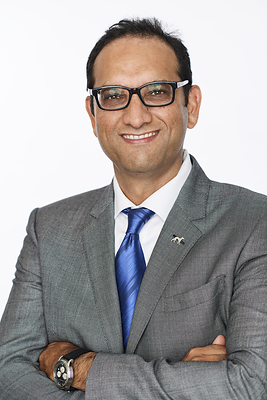
Industry guests attending the event included Steven Newton, Senior Consultant of the U.S. General Services Administration and a member of the Los Angeles Unified School District Procurement Committee; Andrew Stokes, President of MOSO Robotics; and Praveen Penmetsa, founder of Motivo Engineering. They spoke highly of FF’s established industry foundation, technological strength, and compliance capabilities in robotics, as well as the industry alliance initiative proposed by the Company.
FF officially begin recruiting downstream partners and unveil the FF PAR Revenue Flywheel, enabling the Company’s partners to earn not only one-time sales margins, but also recurring income that builds over time as the ecosystem grows, creating higher returns for our partners.
On September 28, FF will host Part Two of the FF EAI Robotics “Built in USA” Launch and Business Partner Conference. Together with our upstream partners, FF will work to build the industry ecosystem. FF’s “Built in USA” strategy will provide a compliant entry point for upstream partners looking to expand into the U.S. market, turning advanced global technologies, supply chains, and system capabilities into market opportunities in the United States.
Against the backdrop of the FCC’s new policy framework, FF, as the first U.S. Company to have delivered both humanoid and bionic robots, is well positioned to capitalize on the market opportunities created by rising industry entry barriers and accelerate the conversion of its first-mover advantage in product delivery into a competitive market advantage.
FF has officially upgraded its EAI robotics strategy to the Four-Core Full-Stack AI Ecosystem Strategy, comprising the EAI Brain; EAI Devices; Industry Productivity Solutions and Developer Platform; and EAI Data Factory.
“Robotics companies fall into two types: EAI robotics companies and non-EAI robotics companies. What sets an EAI robot apart is a combination of critical capabilities, including an intelligent brain, foundation models, a physical embodiment, and the ability to generalize across different tasks and environments. EAI robotics companies tend to bring substantially greater value.” said YT Jia, founder and Global CEO of Faraday Future. “Join us on this ‘Built in USA’ journey. Together, we can move the robotics industry forward and maximize value for every distributor partner who joins us.”
FF EAI Robotics’ “Built in USA” Strategy and FCC Compliance
Built on FF’s “Four-Core Full-Stack AI” ecosystem, FF will build U.S.-based R&D, production, and supply chain capabilities for EAI Devices and key components in phases all while complying with the latest FCC policies targeted towards robotics. At the same time, it will strengthen its U.S. capabilities across the EAI Brain, Industry Productivity Solutions and Developer Platform, and EAI Data Factory. targeting to establish itself as a leading EAI robotics platform company in the United States; and drive the rapid, long-term growth of the U.S. EAI robotics industry.
FF began executing this strategy last year, when it accelerated its EAI robotics business; core Phase One capabilities are now complete.
The new policies recently announced by the FCC are not intended to cut off global collaboration. Advanced technologies and supply chain capabilities from around the world can still be brought into the United States. For global partners, a compliant U.S. platform can still provide a more efficient path into the U.S. market. This is also where FF offers unique value.
FF has already established an evolutionary flywheel driven by its “Four-Core Full-Stack AI” ecosystem, its Global Industry Bridge, and scaled deliveries. Taken together, the new policies are reshaping the rules of the industry and, with full FCC compliance as a prerequisite, further strengthen the value of that bridge — positioning FF to translate its advantages in compliance, global connectivity, and early scaled delivery into market share and a stronger competitive moat.
Three-Phase Execution Roadmap for FF EAI Robotics’ “Built in USA” Acceleration Program
In Phase One, by the end of July this year, FF had completed the initial implementation of three core capabilities: the EAI Brain, Industry Productivity Solutions and Developer Platform, and the EAI Data Factory. This laid the technical foundation for the continued development of its EAI Devices. On the manufacturing side, FF also began establishing Its U.S. footprint, including evaluating a retrofit of the Company’s Hanford factory and possible sites for a new facility.
In Phase Two, from this August through the first quarter of 2027, FF will accelerate the “Assembled in USA” implementation for EAI Devices and the parts required for FCC compliance. FF’s goal is to bring its robotics factory online by the end of this year and have its first new EAI Device roll off the production line in February 2027.
In Phase Three, by the fourth quarter of 2028, FF’s ultimate goal is to achieve “Made in USA” for its EAI Devices, the parts required for FCC compliance, and a group of critical parts capable of driving major advances across the industry.
The following three-phase roadmap and timelines reflect the Company’s current targets and may be adjusted based on current FCC policies, applicable laws and regulations, and actual execution progress.
New EAI Devices Selected for the “Built in USA” Program
The first two new EAI Devices selected for the “Built in USA” program are the full-size humanoid Next Futurist and the quadruped Next Aegis.
Next Futurist is an “All-in-One Professional Expert,” designed for high-value use cases including research and education, industrial applications, services, and inspection. Its key upgrades will focus on motion control, multimodal perception, and AI capabilities. We will also explore advanced technologies such as NVIDIA SONIC, enabling it to progress from motion execution toward task understanding and autonomous operation.
Next Aegis is positioned as an “All-Scenario EAI Quadruped Robot” for education, inspection, security, and other applications at scale. Its key upgrades will focus on power, endurance, complex-terrain mobility, and autonomous navigation. Its modular design will also allow it to be configured for different use cases. More importantly, both products will share the EAI Brain, Data Factory, Developer Platform, and Skills system. Together, they will validate the technical approach of “One Brain, Multiple Forms; Multiple Forms, Multiple Capabilities” and help keep the evolutionary flywheel of FF’s “Four-Core Full-Stack AI” ecosystem moving.
EAI Education Ecosystem Updates
The Company has built the initial foundation of an education ecosystem covering EAI Devices, structured curricula, AI development tools, hands-on robotics training, and teacher support. We have also designed a curriculum framework spanning nine levels and three stages of learning. The Company has established partnerships with two public school districts in California — Lynwood Unified and El Segundo Unified — covering approximately 22 K-12 schools. Our EAI robotics summer camps have validated the model in real educational settings. This has established B2B educational institutions and B2C family education entry points along with a FF representative joining the El Segundo Unified School District’s CTE Advisory Committee.
FF has completed the initial development of Version 1.0 of FF’s Industry Productivity Solution for the EAI Education Ecosystem. It will officially launch on September 19. The solution will serve K-12 schools, after-school programs, and family education. It will empower our partners across eight dimensions, including EAI Devices, level-based curricula, development tools, teacher training, instructional management, and technical support.
FF has also officially launched its EAI EDU Nationwide Replication at Scale Sub-Campaign. Over the next four months, FF will expand its K-12 demonstration programs and advance blended learning, teacher training, and its classroom management platform. FF will also accelerate progress toward implementation for 11 potential education partnerships currently under development across 10 U.S. states.
Partnership Policy & Downstream Partner Recruitment:
FF officially launched its Partnership Policy & Downstream Partner Recruitment at today’s event. FF’s robotics business maintained ramp-up in sales and a positive contribution margin throughout the first half of the year. At the same time, the Data Factory has completed its first commercial closed loop, and the Developer Platform is live.
FF is recruiting four types of partners — each able to create value within the commercial flywheel and share in the returns. Channel partners — including distributors, regional agents, and rental operators, who bring market coverage and local service capabilities. Industry solution partners and developers, who bring industry expertise and project delivery capabilities. AI partners, who contribute Skills modules and model capabilities. And data and Skills partners, who contribute compliant data and validated assets.
FF PAR partners can access two forms of value. Direct value includes product margins and business development incentives. These programs are supported by signed agreements and a fulfillment record. Flywheel value will be created after a robot enters a customer’s real-world environment. This includes deployment, training, operations, software subscriptions, curricula, upgrades, capacity expansion, and referrals. Each of these services is contracted, priced, and accepted independently. None of them constitutes a disguised discount on another.
RoboShare Updates
RoboShare is AIxC’s robot-sharing and operations platform, and FF is AIxC’s majority stockholder. RoboShare aims to build an “Uber + Turo”-style sharing and operations platform for robots. Its goal is to unlock their value as shared assets — transforming them from hardware sold through a one-time transaction into a new type of productive asset capable of generating ongoing revenue. RoboShare has already completed its first paid commercial order and secured a one-year rental order valued at $33,000. This long-term demand led an education customer to expand its original plan to purchase five NAVI robots into a firm order for 23 FFAI robots, generating 18 additional unit sales for FFAI.
AIxC officially launched RoboShare & Co. across North America, offering five partnership models: ROBOPARs support customer development, robot sales, local fulfillment, and lease-to-own programs; asset owners list eligible robots; users access diverse robots with transportation, operation, and on-site services; referral partners introduce customer demand and earn bonuses under official policies; and rental operators provide local transportation, operation, maintenance, repair, and after-sales support. Building on its initial orders, RoboShare is expanding its partner network with the goal of becoming North America’s largest and most diverse robot-sharing platform.
RoboShare is moving beyond its initial orders and beginning to expand its partner network across North America. It aims to build North America’s largest and most diverse robot-sharing platform.
Next, RoboShare will begin rolling out its Ten-City Strategy, starting in Los Angeles. We will validate repeat demand, equipment utilization, and its operating model. FF will provide AIxC with strategic, product, and technology support. In turn, RoboShare will help drive sales through real-world usage.
“FF combines deep roots in the United States with its role as a global Embodied AI industry bridge and today’s conference brought together many new ideas from the Company,” said YT Jia, FF founder and Global CEO. “FF is extending an invitation to all potential partners around the world: Let’s bring the best technologies, products, and supply chain capabilities to the United States, create value here, ‘Built in USA, Benefit the World.’”
About Faraday Future
Founded in 2014, Faraday Future (FF) is a U.S.-based Physical AI ecosystem company dedicated to reshaping the future of robotics and mobility solutions through AI innovation and technologies. FF focuses on two major product strategies within the Embodied AI (EAI) robotics business: EAI humanoid and bionic robots, and EAI automotive-focused robots. By building a “Four-Core Full-Stack AI” ecosystem of EAI Brain, Device, Industry Productivity Solutions and Developer Platform, and Data Factory, FF aims to create an evolutionary flywheel: scaled device delivery, data collection and training, continuous evolution of the EAI Brain, stronger product capability, and even larger-scale delivery and deployment. Through this flywheel, FF seeks to maximize its commercial value and lead to the advancement of Physical AI. For more information, please visit Faraday Future’s official website: ff.com.
Disclaimer
This press release includes “forward looking statements” within the meaning of the safe harbor provisions of the United States Private Securities Litigation Reform Act of 1995. When used in this press release, the words “estimates,” “projected,” “expects,” “anticipates,” “forecasts,” “plans,” “intends,” “believes,” “seeks,” “may,” “will,” “should,” “future,” “propose” and variations of these words or similar expressions (or the negative versions of such words or expressions) are intended to identify forward-looking statements. These forward-looking statements, which include statements regarding Faraday Future Intelligent Electric Inc.’s (the “Company’s”) “Bridge Strategy,” the Company’s growth strategy, fundraising activities and prospects, the development of markets in which the Company operates or seeks to operate, the production and delivery of the FF 91, the Faraday X(FX) brand, and future compliance with Nasdaq listing requirements, are not guarantees of future performance, conditions or results, and involve a number of known and unknown risks, uncertainties, assumptions and other important factors, many of which are outside the Company’s control, that could cause actual results or outcomes to differ materially from those discussed in the forward-looking statements. These forward-looking statements speak only as of the date of this call, and the Company expressly disclaims any obligation or undertaking to disseminate any updates or revisions to any forward-looking statement contained herein to reflect any change in the Company’s expectations with regard thereto or any change in events, conditions or circumstances on which any such statement is based.
Important factors, that may affect actual results or outcomes include, among others: the Company’s ability to continue as a going concern and improve its liquidity and financial position; the Company’s ability to pay its outstanding obligations, which it currently lacks; the availability of sufficient share capital to meet its current obligations and execute on its strategy; the willingness of convertible debt investors to fund the Company; demand for the Company’s robotics products; the ability of B2B preorder companies to locate customers to purchase our robotics products, on which their nonbinding preorders substantially depend; competition in the robotics industry, which includes companies with far superior experience, funding and name recognition; the ability of the Company to build an EAI education ecosystem that serves both the B2C consumer market and the B2B institutional education market; the acceptance by teachers and students of the Company’s robotics products in the education market; the ability of the Company to expand into additional markets for its robotics products; the Company’s reliance on a single OEM for most of its robotics products; the Company’s reliance on Chinese OEMs for all of its robotics products; the possibility of the federal government banning imports of Chinese robotics products; the Company’s ability to get the planned robotics products to comply with all applicable U.S. rules and regulations; the ability of the robotics OEM to timely supply robotics to the Company; tariff uncertainty for imported products, particularly from China; demand from automobile dealers for robotics products; the Company’s ability to homologate FX vehicles for sale; the Company’s ability to secure the necessary funding to execute on the FX strategy, which is substantial; the Company’s ability to secure an occupancy certificate covering all of its Hanford facility; the Company’s ability to remediate its material weaknesses in internal control over financial reporting and the risks related to the restatement of previously issued consolidated financial statements; the Company’s limited operating history and the significant barriers to growth it faces; the Company’s history of substantial losses and expectation of continued losses; the success of the Company’s payroll expense reduction plan; the Company’s ability to execute on its plans to develop and market its vehicles and the timing of these development programs; the Company’s estimates of the size of the markets for its vehicles and cost to bring those vehicles to market; the rate and degree of market acceptance of the Company’s vehicles; the Company’s ability to cover future warranty claims; the success of other competing manufacturers; the performance and security of the Company’s vehicles; current and potential litigation involving the Company; the Company’s ability to receive funds from, satisfy the conditions precedent of and close on the various financings described elsewhere by the Company; the result of future financing efforts, the failure of any of which could result in the Company seeking protection under the Bankruptcy Code; the Company’s indebtedness; the Company’s ability to use its “at-the-market” program; insurance coverage; general economic and market conditions impacting demand for the Company’s products; potential negative impacts of a reverse stock split; potential cost, headcount and salary reduction actions may not be sufficient or may not achieve their expected results; circumstances outside of the Company’s control, such as natural disasters, climate change, health epidemics and pandemics, terrorist attacks, and civil unrest; risks related to the Company’s operations in China; the success of the Company’s remedial measures taken in response to the Special Committee findings; the Company’s dependence on its suppliers and contract manufacturer; the Company’s ability to develop and protect its technologies; the Company’s ability to protect against cybersecurity risks; and the ability of the Company to attract and retain employees, any adverse developments in existing legal proceedings or the initiation of new legal proceedings, and volatility of the Company’s stock price. You should carefully consider the foregoing factors and the other risks and uncertainties described in the “Risk Factors” section of the Company’s Form 10-Q for the quarter ended June 30, 2026; the quarter ended March 31, 2026, filed with the SEC on May 14, 2026, and Form 10-K filed with the SEC on March 31, 2026, and other documents filed by the Company from time to time with the SEC.
Media Contact
john.schilling@ff.com
SOURCE: Faraday Future