All County Collision Publishes Consumer Guidance on Diminished Value Claims After an Accident in Florida
EUSTIS, FL - November 11, 2026 - PRESSADVANTAGE - All County Collision is publishing consumer guidance explaining how
Press Release Disclaimer: This is a press release distributed through the XPR Media network. It has not been independently verified by our newsroom.

EUSTIS, FL – November 11, 2026 – PRESSADVANTAGE –
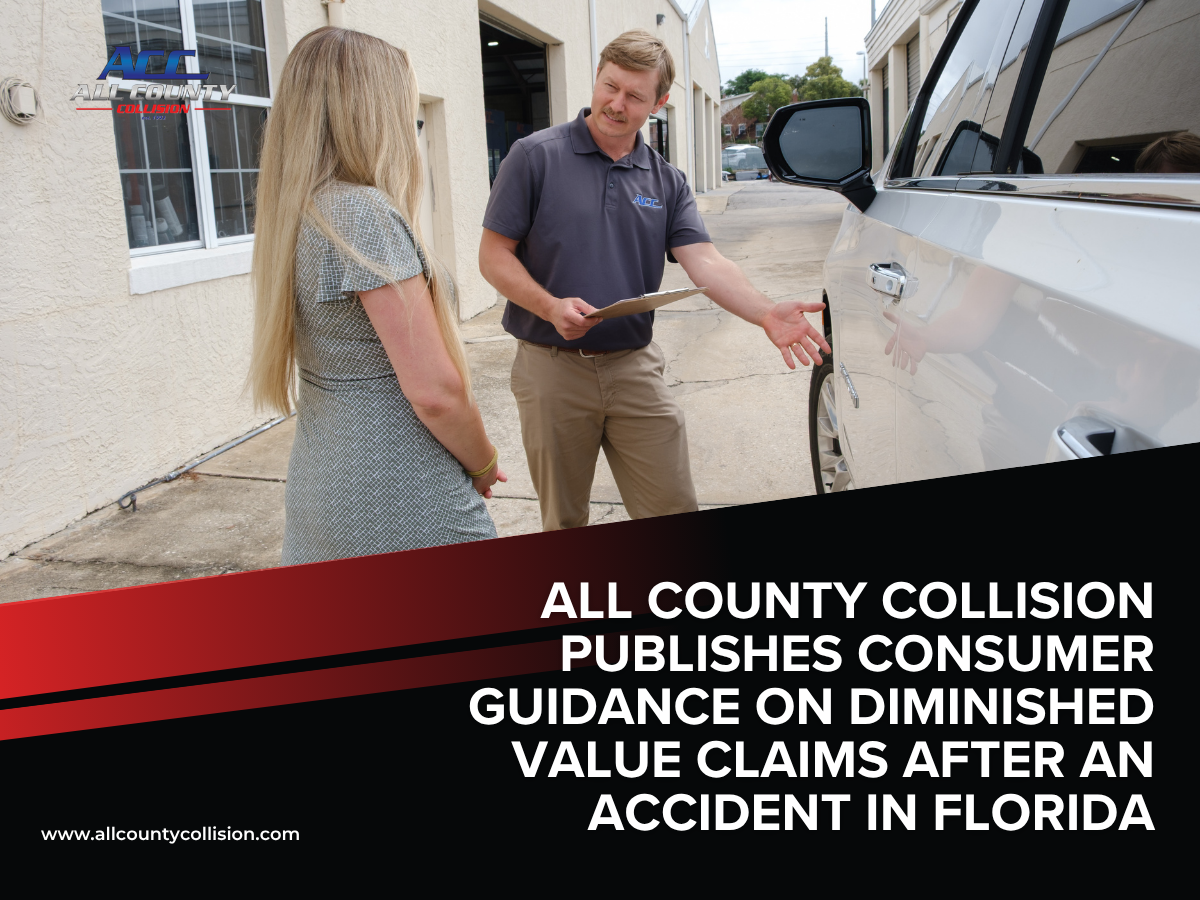
All County Collision is publishing consumer guidance explaining how diminished value claims work after a vehicle accident in Florida. The November publication focuses on what diminished value means, how it differs from collision repair costs, when drivers may have grounds to pursue a claim, and which documents can help support an assessment of a vehicle’s post-accident market value.
After a collision, vehicle owners typically focus on repairing visible damage and returning their vehicles to normal operation. However, completing repairs does not necessarily eliminate the financial effects of an accident. A vehicle may experience a reduction in market value because of its accident history, even when the identified damage has been professionally repaired.
All County Collision provides collision repair services for drivers in Eustis and surrounding Central Florida communities. The new guidance explains why diminished value is a separate consideration from the physical restoration of a damaged vehicle.
Diminished value generally refers to a reduction in a vehicle’s market value associated with an accident or its resulting condition. For example, two vehicles of the same year, make, model, mileage, and similar condition may receive different offers when one has a documented collision history and the other does not.
The difference is not necessarily the same for every vehicle. Accident severity, vehicle age, mileage, market demand, previous damage, and the quality of completed repairs can all influence a potential valuation.
The November guidance distinguishes three commonly discussed forms of diminished value: inherent diminished value, repair-related diminished value, and immediate diminished value.
Inherent diminished value refers to a potential reduction in resale value associated with a vehicle’s accident history, even after appropriate repairs have been completed.
Repair-related diminished value concerns a reduction in value associated with remaining defects or deficiencies in completed repairs. These may involve cosmetic inconsistencies, unresolved mechanical concerns, or other conditions affecting the vehicle.
Immediate diminished value describes the difference in market value immediately following an accident, before repairs have been completed.
The publication emphasizes that these categories are used to describe different valuation circumstances. Their recognition in an individual insurance claim depends on applicable law, the evidence presented, and the specific facts of the accident.
For Florida drivers, an important distinction involves whether a diminished value claim is being pursued against the at-fault driver’s insurer or under the vehicle owner’s own insurance policy.
A third-party diminished value claim may be available when another driver is legally responsible for the accident. In such circumstances, the vehicle owner may seek compensation for a provable reduction in market value, subject to applicable legal requirements and the facts of the claim.
First-party claims under the vehicle owner’s own insurance policy are different. Florida law generally does not require an insurer to compensate an insured for inherent diminished value when the policy provides for repair or replacement of the damaged vehicle, although specific policy terms and circumstances must be considered.
The November guidance encourages drivers to distinguish these situations before assuming that diminished value compensation is included in their existing collision coverage.
Documentation is another central focus of the publication. A diminished value claim generally requires more than stating that a vehicle was involved in an accident.
Vehicle owners may need to establish the vehicle’s pre-accident value, the nature of the collision damage, the repairs performed, and the vehicle’s market value after repairs.
Through its auto body repair services, All County Collision addresses damaged exterior panels and related components. The guidance explains how detailed repair estimates, final invoices, photographs, and inspection records can provide information about the extent of damage and the work completed.
These records may help a qualified vehicle appraiser understand the vehicle’s repair history when assessing its potential market value.
The publication also recommends preserving relevant insurance correspondence, vehicle history information, maintenance records, and comparable vehicle valuations when preparing a claim.
An independent diminished value appraisal may provide an assessment of the vehicle’s potential loss in market value. However, an appraisal does not automatically establish an insurer’s liability or guarantee a particular settlement.
Modern vehicle technology can introduce additional documentation considerations. Vehicles equipped with Advanced Driver Assistance Systems may require diagnostic scanning or manufacturer-specified calibration following certain collision repairs.
All County Collision provides information about these procedures through its ADAS calibration services.
Records showing that applicable electronic system procedures were performed can contribute to the overall repair history. However, completing required calibration does not automatically eliminate an accident-related reduction in resale value.
The November guidance also addresses timing. Drivers considering diminished value compensation should retain documentation early and avoid assuming that all claims follow the same deadlines or settlement procedures.
The applicable time limits, available remedies, and evidence requirements depend on the circumstances and legal basis of the claim. Vehicle owners may benefit from consulting a qualified insurance or legal professional when the amount in dispute is significant.
The publication further explains that insurers may evaluate diminished value claims using different valuation methods. Some assessments consider vehicle age, mileage, damage severity, and market information, while others may rely on additional evidence.
A formula-based calculation does not necessarily reflect every factor affecting an individual vehicle’s resale value. Drivers should understand the basis of a valuation and whether it accounts for the actual vehicle and local market conditions.
For Eustis drivers, the guidance identifies a practical sequence: document the accident, complete the necessary repairs, retain detailed repair records, determine whether a potential diminished value claim is appropriate, and obtain supporting valuation evidence when needed.
The central takeaway is that repairing collision damage and recovering a vehicle’s potential loss in market value are separate matters. A completed repair addresses identified physical damage, while a diminished value claim concerns whether the accident has created a measurable financial loss.
All County Collision’s November publication is intended to help Florida drivers understand these differences and make informed decisions about their vehicle’s repair history, insurance claims, and future resale considerations.
The guidance is provided for general educational purposes and does not constitute legal or insurance advice. Diminished value claim eligibility and compensation depend on the individual circumstances and applicable Florida law.
All County Collision provides collision repair, auto body repair, and ADAS calibration services at 25 S Bay St, Eustis, FL 32726, serving drivers throughout Eustis and surrounding Central Florida communities.
###
For more information about All County Collision, contact the company here:
All County Collision
Ryan DeMarco
3523574599
ryan@allcountycollision.com
25 S Bay Street, Eustis, FL 32726