Ceramic Tableware Market Set to Hit USD 38.34 Billion by 2035 as Demand Accelerates
Manufacturing modernization, evolving food-contact standards and rising hospitality demand are reshaping ceramic
Press Release Disclaimer: This is a press release distributed through the XPR Media network. It has not been independently verified by our newsroom.

Manufacturing modernization, evolving food-contact standards and rising hospitality demand are reshaping ceramic tableware markets worldwide.
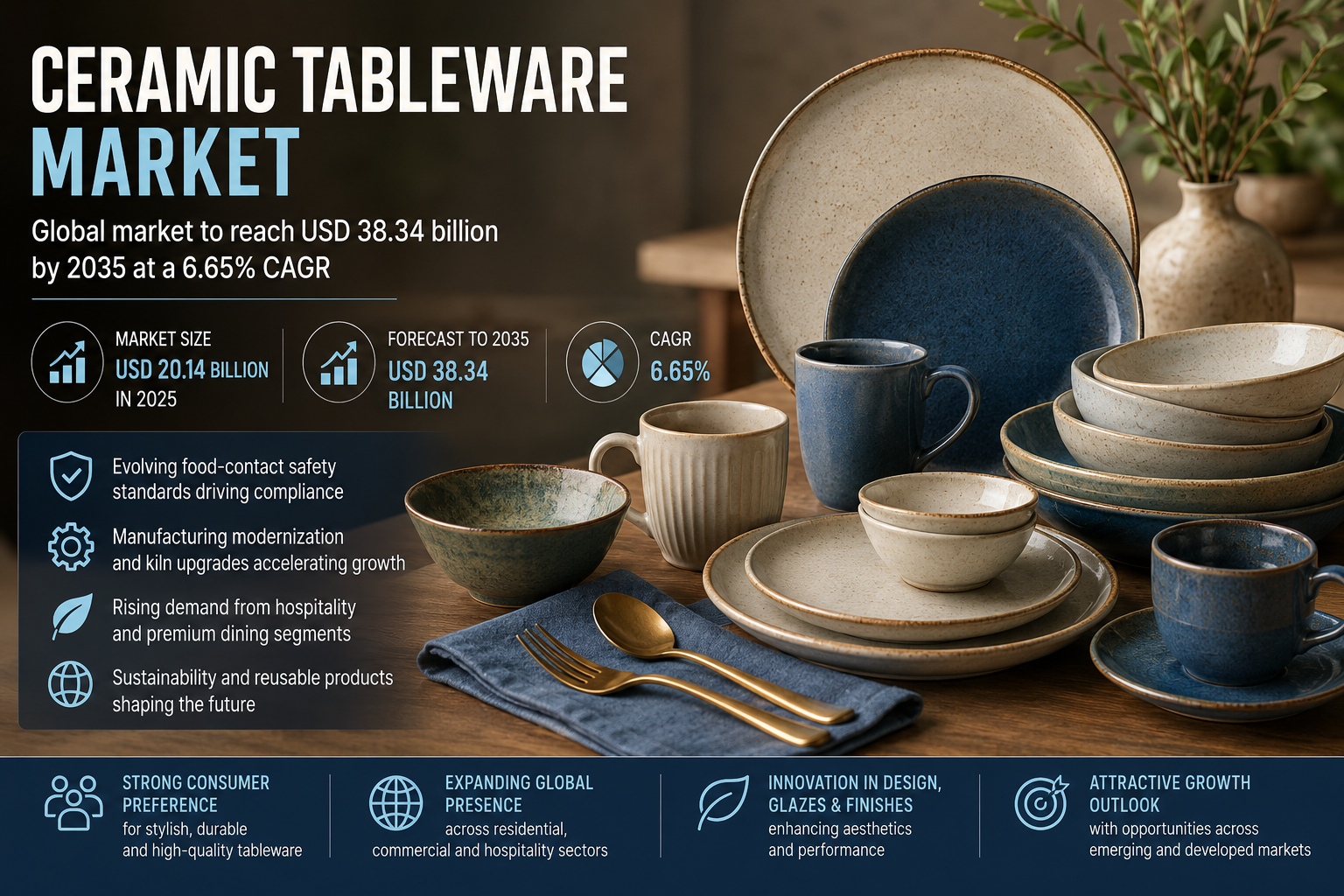
NEW YORK, NY, UNITED STATES, August 25, 2026 /EINPresswire.com/ — The global Ceramic Tableware Market is entering a sustained expansion phase, with market valuation projected to increase from USD 20.14 billion in 2025 to USD 21.48 billion in 2026 and reach USD 38.34 billion by 2035, representing a 6.65% compound annual growth rate (CAGR) during the forecast period.
The growth trajectory reflects a combination of changing consumer dining habits, expanding hospitality and foodservice activity, premiumization across residential tableware, increasing preference for durable reusable products and continuing innovation in ceramic manufacturing. At the same time, evolving food-contact safety requirements are placing greater emphasis on material composition, glaze performance, testing, traceability and production-process control.
Ceramic tableware—including plates, bowls, cups, mugs, serving dishes, cookware and related dining products—continues to occupy a central position in household and commercial food service. Its combination of durability, heat resistance, aesthetic flexibility and broad design potential has enabled ceramic products to compete across mass-market, premium, artisanal and institutional segments.
Market Growth Supported by Shifting Dining and Hospitality Trends
The projected expansion of the ceramic tableware market is closely connected to the continued development of the global hospitality and foodservice industries. Restaurants, hotels, cafés, catering businesses and institutional food operators increasingly require tableware that can withstand repeated handling, washing and thermal cycling while maintaining visual consistency.
Ceramic products offer manufacturers and buyers a broad design platform. Product differentiation can be achieved through shape, glaze, texture, colour, decoration and surface finish, allowing tableware brands to address everything from everyday household dining to premium restaurant presentation.
In residential markets, consumers are also showing continued interest in tableware that combines functionality with visual appeal. Dinnerware is increasingly treated as part of interior styling and entertaining rather than simply as a utilitarian household purchase. This trend is creating opportunities for manufacturers offering coordinated collections, seasonal designs, artisanal finishes and premium materials.
Meanwhile, the commercial sector is placing greater emphasis on durability and total cost of ownership. Hospitality operators may prioritize products that can tolerate frequent commercial dishwashing and repeated service cycles, making product quality, breakage rates and replacement availability important purchasing considerations.
Get Full PDF Sample Copy of Report: (Including Full TOC, List of Tables & Figures, Chart) @ https://www.marketresearchfuture.com/sample_request/28589
Food-Contact Regulations Put Compliance at the Centre of Manufacturing
Regulatory developments represent another important factor shaping the competitive landscape.
The European Commission has initiated work to revise EU rules covering ceramic and vitreous food-contact materials. According to the Commission, current scientific evidence indicates a need to significantly lower migration limits for lead and cadmium and to consider limits for additional substances including aluminium, arsenic, barium, cobalt, chromium and nickel. The proposed wider framework is intended to address ceramic as well as other vitreous food-contact materials such as glass, crystal and enamelled metals.
The existing EU Ceramic Articles Directive, Directive 84/500/EEC, already establishes limits for lead and cadmium migration from ceramic articles intended to come into contact with food. The directive sets different limits according to product categories and specifies testing requirements for determining migration levels.
For manufacturers and exporters, the regulatory direction means that compliance is increasingly becoming a competitive capability rather than a simple documentation exercise. Producers may need to review raw materials, pigments, glazes, firing conditions, testing protocols and supplier controls to ensure that finished products meet applicable food-contact requirements.
The European Commission has also acknowledged that regulatory changes can create particular challenges for traditional and artisanal producers, including potential costs associated with replacing ovens or modifying materials and production methods. The Commission is therefore examining potential mitigating measures and transition arrangements as part of the wider revision process.
This evolving environment is expected to encourage investment in testing, quality assurance, process monitoring and cleaner manufacturing technologies across the ceramic tableware value chain.
Manufacturing Modernization Creates New Opportunities
Modernization is becoming increasingly important for ceramic producers seeking to compete on quality, consistency, energy efficiency and regulatory compliance.
Traditional ceramic production can be highly dependent on kiln performance, firing temperature, glaze formulation and operator expertise. Improvements in kiln design, automation, process monitoring and energy management can help manufacturers achieve more consistent output while reducing production losses.
India provides an important example of the modernization opportunity. The country’s Ministry of MSME has supported technological interventions in the pottery sector, including the development and introduction of energy-efficient pottery machinery and kiln technologies. Government-supported initiatives have also involved institutions such as the Central Glass and Ceramic Research Institute in Khurja.
Khurja remains an important Indian pottery and ceramic manufacturing centre. Government documentation describes common-facility infrastructure supporting processes including body-mix preparation, glaze preparation, fabrication and firing, with modernization aimed at improving product quality, consistency and competitiveness.
The supplied market brief additionally estimates that approximately USD 46 million has been channelled into kiln modernization across the Khurja and Morbi clusters since 2023. This figure should be treated as an industry estimate unless supported by a specific government funding record.
Such investment, whether undertaken through public programmes, private capital or cluster-level initiatives, can have a multiplier effect. Modern kilns and production equipment can improve throughput, reduce defects, support more consistent firing profiles and potentially help manufacturers meet increasingly demanding export specifications.
Premiumization Reshapes Ceramic Tableware Demand
Premiumization represents another important growth opportunity.
Consumers are increasingly willing to pay for differentiated tableware that communicates craftsmanship, design quality and lifestyle positioning. Premium ceramic products can command higher prices through specialized glazes, handmade finishing, distinctive forms, limited collections and collaborations with designers or hospitality brands.
The trend is particularly relevant to restaurants and hotels that use tableware as part of the customer experience. In premium dining, the plate or serving vessel is not merely functional; its shape, colour, texture and proportion can influence food presentation and brand identity.
This creates opportunities for ceramic manufacturers to move beyond volume-based competition and develop specialized product portfolios for restaurants, hotels, chefs, retailers and design-conscious consumers.
Sustainability Supports Reusable Tableware
Sustainability considerations are also influencing purchasing decisions.
Ceramic tableware is reusable and can serve for extended periods when appropriately manufactured, handled and maintained. This creates opportunities in settings where businesses and institutions are seeking alternatives to disposable food-service products.
The shift toward reusable products can be particularly relevant in institutional catering, corporate cafeterias, education facilities, healthcare food service and hospitality. Buyers increasingly evaluate not only the initial purchase price but also durability, expected service life, replacement frequency and operational performance.
For manufacturers, sustainability can therefore become a product-development and marketing opportunity. Energy-efficient firing, responsible raw-material sourcing, waste reduction, optimized packaging and longer product lifecycles can strengthen the value proposition of ceramic tableware.
Asia-Pacific Remains a Key Manufacturing and Consumption Hub
Asia-Pacific is expected to remain strategically important to the global ceramic tableware industry because of its extensive manufacturing base, established supply chains, growing middle-class consumer markets and expanding hospitality sector.
China and India are particularly important production centres, while other Asian economies contribute to the regional manufacturing ecosystem. The combination of manufacturing capabilities and domestic consumption provides opportunities for both established producers and smaller specialized manufacturers.
India, in particular, has a deep tradition of ceramic and pottery production supported by clusters, skilled artisans and established domestic demand. Government initiatives involving technology development, common facilities and entrepreneurship support can help smaller enterprises improve productivity and market access.
At the same time, manufacturers targeting international markets must increasingly consider regulatory requirements in destination countries. Compliance with food-contact standards, documentation, product testing and traceability can become decisive factors in export competitiveness.
Europe Focuses on Safety, Quality and Compliance
Europe represents another strategically important market, particularly for premium ceramic tableware and hospitality applications.
European buyers have historically placed strong emphasis on product design, craftsmanship, quality and regulatory compliance. The ongoing review of food-contact requirements adds another layer of technical consideration for producers supplying the European market.
The Commission’s work indicates that future requirements could extend beyond existing lead and cadmium controls to cover additional metals. This potentially broadens the scope of material testing and production controls required from manufacturers.
For exporters, early preparation could become an important competitive advantage. Manufacturers capable of demonstrating consistent testing, controlled formulations and reliable compliance documentation may be better positioned to maintain relationships with European distributors and institutional buyers.
Fragmented Competitive Landscape Encourages Product Differentiation
The ceramic tableware industry remains relatively fragmented, with competition spanning large international brands, regional manufacturers, specialized hospitality suppliers, artisanal producers and private-label manufacturers.
This fragmentation creates opportunities for companies that can combine manufacturing scale with product innovation and regulatory capabilities.
Large manufacturers may benefit from purchasing power, automated production, extensive distribution networks and established hospitality relationships. Smaller producers, meanwhile, can compete through design flexibility, customization, artisanal craftsmanship and rapid response to niche market requirements.
Digital commerce is further expanding opportunities for smaller brands by allowing them to reach consumers without relying exclusively on traditional retail distribution. Social media, online marketplaces and direct-to-consumer platforms can provide additional channels for showcasing distinctive designs and building brand recognition.
Technology Will Influence the Next Stage of Market Development
Technology adoption is expected to play an increasingly important role throughout the forecast period.
Automation can improve production consistency, while advanced kiln controls can help manufacturers optimize firing conditions. Digital design technologies can accelerate product development, and improved testing systems can support regulatory compliance.
Manufacturers are also expected to explore technologies that reduce energy consumption and production waste. Because firing is one of the most energy-intensive stages of ceramic production, kiln efficiency can directly influence manufacturing economics as well as environmental performance.
The ability to integrate design, manufacturing, testing and supply-chain data could therefore become a significant differentiator over the next decade.
Outlook Through 2035
With the market projected to grow from USD 20.14 billion in 2025 to USD 38.34 billion by 2035, the ceramic tableware industry is positioned for a period of meaningful structural development.
The anticipated 6.65% CAGR reflects more than simple volume growth. It points toward an industry being reshaped by premiumization, hospitality expansion, sustainability considerations, manufacturing modernization and increasingly sophisticated food-contact compliance requirements.
Companies operating in the sector are likely to focus on several strategic priorities: improving product durability, expanding premium collections, strengthening regulatory compliance, investing in energy-efficient manufacturing, developing customized hospitality solutions and building resilient supply chains.
For buyers, product selection is also becoming more sophisticated. Cost remains important, but durability, consistency, safety documentation, pattern continuity, replacement availability and environmental considerations can increasingly influence purchasing decisions.
For investors and manufacturers, the market’s fragmented structure provides opportunities for consolidation, specialization and technology-led differentiation. Businesses with strong manufacturing capabilities combined with compliance expertise and established hospitality or retail relationships may be particularly well positioned to capture value as the industry evolves.
Discover Related Research Reports By Market Research Future:
Ceramic Coating Cookware Market
https://www.marketresearchfuture.com/reports/ceramic-coating-cookware-market-36389
Ceramic Machinery Market
https://www.marketresearchfuture.com/reports/ceramic-machinery-market-27382
Enameled Cookware Market
https://www.marketresearchfuture.com/reports/enameled-cookware-market-12465
Market Research Future
Market Research Future
+1 855-661-4441
email us here
Legal Disclaimer:
EIN Presswire provides this news content “as is” without warranty of any kind. We do not accept any responsibility or liability
for the accuracy, content, images, videos, licenses, completeness, legality, or reliability of the information contained in this
article. If you have any complaints or copyright issues related to this article, kindly contact the author above.

Media gallery