DentScribe White Paper Reveals Why Diagnosed Treatment Goes Unscheduled
SUNNYVALE, Calif., Aug. 31, 2026
Press Release Disclaimer: This is a press release distributed through the XPR Media network. It has not been independently verified by our newsroom.

DentScribe White Paper Reveals Why Diagnosed Treatment Goes Unscheduled
PR Newswire
SUNNYVALE, Calif., Aug. 31, 2026
New white paper shows Treatment Coordinator Notes can reveal why diagnosed care goes unscheduled and how practices can recover it.
SUNNYVALE, Calif., Aug. 31, 2026 /PRNewswire/ — The dentist diagnosed the treatment. The patient understood the need. The fee was discussed. Then nothing got scheduled.
For most dental practices, that moment disappears.
DentScribe is making it visible.
DentScribe, the AI platform for dental documentation and production, today released a new white paper showing that the most important production leak in dentistry may not be in the operatory. It may be in the ninety seconds after the doctor leaves the room.
The white paper, “The Last Undocumented Conversation in Dentistry,” analyzes structured Treatment Coordinator Notes. These notes document what actually happened after the appointment: whether the treatment plan was reviewed, whether the patient heard a clear financial number, whether payment options were discussed, whether objections were answered, whether scheduling was attempted, and whether next steps were assigned.
The findings are direct:
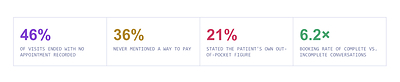
- 46% of visits ended with no appointment recorded.
- 36% never mentioned a way to pay.
- Only 21% gave the patient their own out-of-pocket figure.
- Complete conversations booked at 6.2× the rate of incomplete conversations.
- $65,696 in quoted treatment remained unresolved in the sample.
- 98 office commitments were made, but none had an owner or due date in the note.
That is the production leak.
Not a bad diagnosis. Not a bad doctor. Not always even a patient refusal.
Often, the conversation simply did not complete.
“Dentistry has excellent systems for recording what was done,” said Dr. Vinni K. Singh, DDS, AFAAID, Founder and CEO of DentScribe. “But the decision about whether treatment happens is often made in a conversation that no system records. DentScribe Treatment Coordinator Notes change that.”
DentScribe Treatment Coordinator Notes capture the post-appointment conversation and structure it into seven sections: treatment plan review, financial discussion, payment options, objection handling, emotional support, scheduling, and next steps.
That structure is the breakthrough.
A free-text note helps one person remember. A structured note helps the whole practice learn.
With structured TC Notes, a practice owner can ask:
Did we explain the plan?
Did we give the patient the number they actually needed to decide?
Did we offer a way to pay?
Did we ask for a date?
Did we answer the real objection?
Did we promise a callback?
Did anyone own it?
Those questions were previously almost impossible to answer at scale.
DentScribe’s white paper shows that complete conversations — those covering the five case-acceptance essentials of plan, financials, payment options, scheduling, and next steps — booked at 62%. Conversations covering three or fewer booked at 10%.
The paper is careful not to treat that as a causal claim. Good conversations are more likely to complete, and completed conversations are more likely to book. But one part of the finding is operationally obvious: a scheduling conversation that never happens cannot produce an appointment.
For DSOs and multi-location groups, the implications are significant. Case acceptance has usually been managed as an outcome metric: measured after the fact, attributed to talent, and addressed with broad training.
DentScribe turns it into a process metric.
Leaders can now see which steps occurred, which steps were skipped, what patients actually objected to, what financial levers were offered, which commitments were made, and which follow-ups are still open.
“You cannot coach what you cannot see,” said Dr. Ratinder Paul Singh Ahuja, Ph.D., Board Chair of DentScribe. “DentScribe makes the treatment coordinator conversation visible, measurable, and coachable. That gives DSOs and practice owners a new way to improve production without adding chairs, adding providers, or adding marketing spend.”
The white paper found that cost was not always the dominant objection inside the actual TC conversation. In the sample, patients more often asked clinical questions, sought reassurance, or wanted time to think. Fear and discomfort were the least consistently answered category.
That matters because not every objection requires a discount.
Some require clarity.
Some require reassurance.
Some require a phased plan.
Some require financing.
Some require a callback within 72 hours before the diagnosis goes cold.
DentScribe Treatment Coordinator Intelligence helps practices identify those patterns and act on them.
The operating rhythm is simple:
Daily: assign every office commitment from yesterday’s notes.
Weekly: work every quoted-but-unbooked case while it is still warm.
Weekly: coach one coordinator on one measurable conversation step.
Monthly: review the top patient friction categories and agree responses.
Quarterly: audit financial clarity: did the patient know what they would pay?
This is not about blaming treatment coordinators. It is about giving them a system.
Treatment coordinators are asked to translate clinical findings into patient decisions. They discuss money, insurance, fear, timing, financing, family input, scheduling, and trust, all while preserving the relationship. DentScribe gives owners and DSOs a constructive way to support that work with real examples, real trends, and real coaching opportunities.
“The goal is not pressure,” said Dr. Singh. “The goal is clarity. Patients deserve to understand the care being recommended, the cost, the options, and the next step. Teams deserve feedback based on facts, not guesses.”
DentScribe’s broader AI platform already helps dental teams generate structured SOAP notes, reduce documentation burden, and turn clinical notes into production insight through CoPilot and GPS. Treatment Coordinator Notes extend that intelligence beyond the operatory and into the business conversation where treatment is either scheduled, delayed, or lost.
The white paper’s central argument is simple:
The practice does not lose most of its production in the operatory.
It loses it in the corridor afterwards.
DentScribe is bringing that conversation into the light.
Ready to see the production your practice may be leaving invisible?
Book a demo: https://www.dentscribe.ai/book-a-demo
About DentScribe
DentScribe (SuhaviAI, Inc.) is the AI platform for dental documentation and production. DentScribe automatically generates comprehensive SOAP notes from dentist-patient conversations and publishes them directly into leading practice management systems. With DentScribe CoPilot, those notes become chairside checklists that close care gaps and increase case acceptance. With DentScribe GPS, leaders gain a practice-wide daily brief that turns morning huddles into a reliable engine for production and patient outcomes. Founded by practicing dentist Dr. Vinni K. Singh in Sunnyvale, California, DentScribe helps dentists reclaim time, deliver better care, and grow their practices—without changing how they work. Learn more or book a demo at dentscribe.ai.
Media Contact
DentScribe
hello@dentscribe.ai
+1-650-446-6161
710 Lakeway Dr. #200, Sunnyvale, CA 94085

 View original content to download multimedia:https://www.prnewswire.com/news-releases/dentscribe-white-paper-reveals-why-diagnosed-treatment-goes-unscheduled-302865010.html
SOURCE DentScribe